

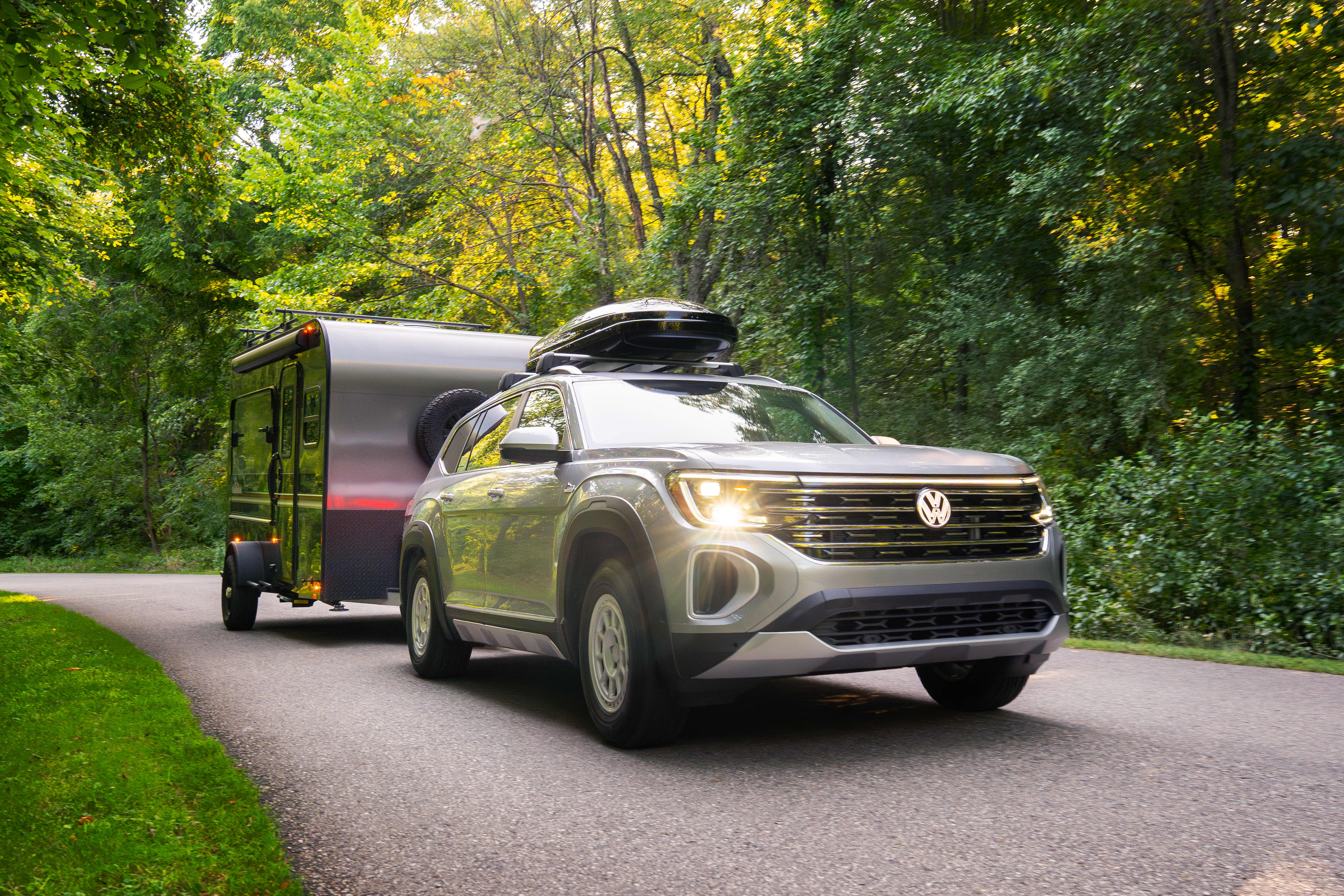
Preparing a vehicle for towing requires understanding both its physical limits and the specific hardware needed to connect a load safely. When properly configured, a modern SUV provides a highly versatile platform for hauling trailers, mounting rack systems, and transporting outdoor equipment. For boaters launching a skiff into the Intracoastal Waterway near Little River, having a properly configured vehicle makes the difference between a smooth day on the water and a stressful ramp experience. Choosing the correct setup prevents mechanical strain and ensures compliance with highway safety standards.
To begin configuring your vehicle for utility, the first step is identifying the class of receiver hitch required for your trailer. Most midsize SUVs utilize a Class III receiver hitch, which is rated to handle up to 5,000 lbs of trailer weight. The SE with 4MOTION and higher trims of our larger SUVs come prepared for these demands, featuring robust frame mounting points and integrated wiring connectors. Utilizing genuine components ensures that your electrical systems, including taillights and turn signals, sync perfectly with the trailer.
Our showroom address at 8756 Us Highway 17 Byp, South, Myrtle Beach, SC 29588 is where we help drivers configure their vehicles. If you have questions about which setup fits your trailer, give our team a quick call to speak with an expert.
Table of Contents
- Understanding Towing Limits: GVWR, GCWR, and How Passengers and Cargo Affect Capacity
- Braked versus Unbraked Towing and the Role of Tongue Weight in Safety
- The Truth About Weight Distribution Hitches and Factory Towing Equipment
- Maximizing Roof Storage: High-End Gear Racks, Costs, and Common Loading Mistakes
- Warranty Protection, Vehicle Break-In, and Towing Maintenance Guidelines
- Common Questions About Volkswagen Towing and Outdoor Accessories
- Get Ready for Your Next Journey with Volkswagen
Understanding Towing Limits: GVWR, GCWR, and How Passengers and Cargo Affect Capacity
How does a vehicle's maximum towing capacity change when you pack the cabin with luggage and passengers? Many drivers assume that if an SUV is rated to tow 5,000 lbs, they can pull a trailer of that weight regardless of how much gear is loaded inside the vehicle. In reality, towing capacity is a dynamic figure that decreases as the weight inside the vehicle rises. To calculate your true towing limit, you must understand several key manufacturer weight ratings.
The first metric is the Gross Vehicle Weight Rating (GVWR), which represents the maximum allowable weight of the vehicle itself, including passengers, fuel, cargo, and the tongue weight of the trailer. The Gross Combined Weight Rating (GCWR) is the absolute maximum weight of both the tow vehicle and the trailer combined, including all onboard cargo. To find your actual towing capacity, you must subtract the vehicle’s curb weight and its internal payload from the GCWR.
When you load a family and their vacation luggage into the cabin, that payload directly reduces the remaining weight you can safely tow. Exceeding either the GVWR or the GCWR puts extreme stress on the suspension, transmission, and braking systems, which can compromise steering control and increase stopping distances. Keeping a safety buffer of at least 20% below these maximum ratings is a highly recommended industry practice.
If you are trying to decide which model fits your hauling needs, taking our car buying quiz can narrow down your choices. For those considering a pre-owned model, we recommend reviewing our used car checklist before exploring our used vehicle inventory online.
Dimensions & Capacity
Capacity and dimensions by trim
| Feature | Atlas Peak Edition | SE | SE w/Tech | SEL | SEL Premium R-Line |
|---|---|---|---|---|---|
| Seating | 7 | 7 | 7 | 7 | 7 |
| Cargo | 20.6 cu ft | 20.6 cu ft | 20.6 cu ft | 20.6 cu ft | 20.6 cu ft |
| Curb weight | 4,594 lbs | 4,317 lbs | 4,317 lbs | 4,636 lbs | 4,636 lbs |
| Towing | 5,000 lbs | 2,000 lbs | 5,000 lbs | 5,000 lbs | 5,000 lbs |
| Payload | 1,102 lbs | 1,102 lbs | 1,102 lbs | 1,102 lbs | 1,102 lbs |
Braked versus Unbraked Towing and the Role of Tongue Weight in Safety
A common misconception is that any trailer can be pulled safely without modifying the vehicle's braking habits. Towing capacities are divided into braked and unbraked categories. Unbraked towing capacity refers to the maximum weight the vehicle can pull when the trailer relies entirely on the SUV's brakes to stop. This limit is always significantly lower because the vehicle's braking system must absorb the kinetic energy of both masses.
Braked towing capacity applies when the trailer is equipped with its own independent braking system, which is activated in tandem with the vehicle's brake pedal. In South Carolina, state law requires independent trailer brakes on any trailer that exceeds a gross weight of 3,000 lbs. Operating a heavy trailer without active trailer brakes is highly dangerous and legally non-compliant.
Proper weight distribution is equally vital, specifically concerning tongue weight, which is the downward force exerted by the trailer coupler onto the hitch ball. Ideally, tongue weight should represent 10% to 15% of the total loaded trailer weight.
- Too little tongue weight causes the trailer to fish-tail, leading to dangerous trailer sway at highway speeds.
- Too much tongue weight overloads the rear axle, lifting the front wheels and severely reducing steering traction and braking effectiveness.
For drivers navigating the flat coastal roads and bridges around Wilmington, managing trailer sway is especially critical when dealing with sudden Atlantic crosswinds. To ensure your vehicle's braking system is up to the task, you can schedule a service appointment with our technicians. If you need to install an OEM trailer brake controller or wiring harness, our parts department can supply the correct components. Additionally, for those interested in the latest electric utility options, we invite you to browse our new ID. Buzz inventory.
The Truth About Weight Distribution Hitches and Factory Towing Equipment
Imagine hooking up a heavy camper and noticing the rear of your SUV sagging while the front wheels lift slightly off the ground. To correct this uneven stance, some drivers look to a weight distribution hitch. It is vital to understand that a weight distribution hitch does not increase your vehicle's manufacturer-rated towing capacity. Instead, it uses spring bars to distribute the tongue weight across all axles of both the tow vehicle and the trailer, leveling the ride and improving steering, braking, and stability.
While a weight distribution hitch optimizes how a load is carried, the vehicle's maximum towing capacity is ultimately determined by its factory-installed mechanical components. These include:
- Heavy-duty engine cooling systems to prevent overheating under load.
- Upgraded alternators to handle the electrical draw of trailer lights and accessories.
- Transmission coolers that protect the gearbox from heat-induced fluid breakdown.
- Specific axle ratios designed to maximize torque delivery.
For example, the SE trim of the Atlas Cross Sport has a base towing capacity of 2,000 lbs without the full hitch package, but higher trims like the SEL with its factory-installed hitch enable the full 5,000 lbs towing capacity. If you want to upgrade to a vehicle with factory-equipped towing features, you can value your trade-in with us today. From there, you can explore our new Atlas Cross Sport inventory or check out our electric options in the new ID.4 inventory.
Maximizing Roof Storage: High-End Gear Racks, Costs, and Common Loading Mistakes
When planning a road trip, utilizing roof storage is an excellent way to preserve cabin space, but it requires careful execution to avoid common mistakes. High-end roof rack systems provide a secure foundation for cargo boxes, kayak carriers, and bike mounts. In 2026, a complete premium roof rack system consisting of base carrier bars and towers typically costs between $500 and $800, while specialized attachments like aerodynamic cargo boxes or dual-bike carriers add an additional $200 to $1,200.
While these systems are designed to withstand highway speeds, several loading mistakes can compromise safety and vehicle efficiency:
- Exceeding the roof's weight capacity, which is typically limited to 165 lbs on most midsize SUVs.
- Placing heavy items on the roof rather than in the cabin, which raises the vehicle's center of gravity and negatively impacts cornering stability.
- Ignoring aerodynamic drag by packing loose, unshaped items, which can dramatically decrease fuel economy.
- Failing to double-check strap tension after the first few miles of driving, as loads frequently shift.
When shopping for a spacious SUV to accommodate these rack systems, pricing varies across the lineup. For example, the Atlas SE starts at a base MSRP of $39,310, the SE w/Tech is priced at $43,730, the Atlas Peak Edition starts at $48,060, the SEL is listed at $49,620, and the SEL Premium R-Line comes in at $54,630, with all of these configurations subject to a $1,475 destination charge.
To get started on your purchase, you can use our online resources for prequalifying for a vehicle loan to see your options. If you prefer a smaller footprint, you can browse our new Taos inventory or check out the sporty performance in our new Golf GTI inventory.
Pricing
Pricing by trim
| Feature | Atlas Peak Edition | SE | SE w/Tech | SEL | SEL Premium R-Line |
|---|---|---|---|---|---|
| Base MSRP | $48,060 | $39,310 | $43,730 | $49,620 | $54,630 |
| Destination charge | $1,475 | $1,475 | $1,475 | $1,475 | $1,475 |
Warranty Protection, Vehicle Break-In, and Towing Maintenance Guidelines
Maintaining a vehicle that frequently pulls heavy loads requires a more rigorous service schedule than a standard daily commuter. Towing within your vehicle's manufacturer-specified limits will not void your warranty, but neglecting proper maintenance or failing to observe the initial break-in period can lead to denied claims if mechanical failures occur. Following the correct procedures protects your powertrain and ensures long-term reliability.
During walk-arounds on our lot, buyers frequently ask whether they need to wait before hooking up a camper. We always advise them that driving the first 1,000 miles without a heavy load is crucial for letting the drivetrain components seat properly. This initial break-in period allows the engine, transmission, and differential gears to wear in evenly under normal operating conditions before being subjected to the extreme heat and stress of towing.
For vehicles used for frequent hauling, switching to a heavy-duty maintenance schedule is essential. This typically means doubling the frequency of transmission and differential fluid inspections. Under heavy loads, transmission fluid runs much hotter, accelerating its thermal breakdown and reducing its lubricating properties.
If you are ready to find a capable vehicle, explore our new Volkswagen inventory. The three-row Volkswagen Atlas is an exceptional choice for heavy hauling, while those looking for a compact option can browse our new Tiguan inventory.
Common Questions About Volkswagen Towing and Outdoor Accessories
Before heading out on your next excursion, understanding the logistics of hauling can prevent unexpected issues. Here are some of the most common questions our team receives regarding towing, safety, and vehicle capability.
Q: Does standard auto insurance cover damage to the towed trailer?
Standard auto insurance typically provides liability coverage for the trailer while it is physically attached to your vehicle, meaning it covers damage the trailer causes to others. However, comprehensive and collision coverage for the trailer itself usually requires a separate trailer policy or an endorsement.
Q: How does towing affect the fuel efficiency of a turbocharged engine?
Towing significantly increases aerodynamic drag and engine load, which will cause your fuel economy to drop. A turbocharged engine will operate under higher boost pressures more frequently, which can reduce your highway fuel economy by roughly 30% to 50% depending on the weight and frontal area of the trailer.
Q: Can I install a roof rack on smaller models like the Jetta or Golf?
Yes, smaller models are fully compatible with specialized roof rack systems. You can find custom-fit base carrier bars for a hatchback like the Volkswagen Golf or browse our new Jetta inventory to find a sedan that can be equipped with roof-mounted bike or ski racks.
Q: What should I do if my trailer begins to sway while driving?
If your trailer begins to sway, maintain a steady grip on the steering wheel, keep the vehicle pointed straight, and gradually back off the accelerator. Do not slam on the brakes or try to steer out of the sway, as this can worsen the instability.
Q: How can I find your location to discuss towing accessories in person?
You can easily find our dealership to speak directly with our parts and service teams. We can help you select, order, and install certified towing hitches and roof racks designed specifically for your vehicle.
Get Ready for Your Next Journey with Volkswagen
Equipping your vehicle with the right towing gear and roof racks opens up a world of outdoor possibilities. Whether you choose the Atlas SE with front-wheel drive or the Atlas Peak Edition with all-wheel drive, you will benefit from a turbocharged 2.0L engine delivering 269 hp and 273 lb-ft of torque paired with a smooth 8-speed automatic transmission. These robust specifications ensure that your vehicle remains composed and responsive, even when hauling up to 5,000 lbs of cargo.
Should you encounter any unexpected issues while on the road, remember that manufacturer-backed support is always available. You can contact Volkswagen Roadside Assistance: 800-411-6688 for emergency support, flat tire changes, or towing coordination to an authorized service center.
To explore our capable lineup in person, we invite you to visit our online virtual showroom. You can also get easy directions to our Myrtle Beach showroom or give us a call at (843) 353-1118 to schedule a test drive.
Engine & Performance
Powertrain specs by trim
| Feature | Atlas Peak Edition | SE | SE w/Tech | SEL | SEL Premium R-Line |
|---|---|---|---|---|---|
| Engine | 2.0L | 2.0L | 2.0L | 2.0L | 2.0L |
| Horsepower | 269 hp | 269 hp | 269 hp | 269 hp | 269 hp |
| Torque | 273 lb-ft | 273 lb-ft | 273 lb-ft | 273 lb-ft | 273 lb-ft |
| Transmission | 8-speed automatic | 8-speed automatic | 8-speed automatic | 8-speed automatic | 8-speed automatic |
| Drivetrain | All-wheel drive | Front-wheel drive | Front-wheel drive | All-wheel drive | All-wheel drive |
© 2026 East Coast Volkswagen. All rights reserved.
Categories:
Comparisons